
Books
Knowledge Cartography
Software Tool and Mapping Techniques
Okada, A., Buckingham Shum, S. and Sherborne, T.
ISBN:978-1-84800-148-0
Springer: Advanced Information and Knowledge Processing Series.
Knowledge Cartography is the discipline of mapping intellectual landscapes.
The focus of this book is on the process by which manually crafting interactive, hypertextual maps clarifies one's own understanding, as well as communicating it.
The authors see mapping software as a set of visual tools for reading and writing in a networked age. In an information ocean, the primary challenge is to find meaningful patterns around which we can weave plausible narratives. Maps of concepts, discussions and arguments make the connections between ideas tangible and disputable.
With 17 chapters from the leading researchers and practitioners, the reader will find the current state-of-the-art in the field. Part 1 focuses on educational applications in schools and universities, before Part 2 turns to applications in professional communities, but with many cross-cutting themes:
- conceptual frameworks for understanding knowledge cartography
- visual languages, many of which work on both paper and with software
- specialist software, much of it freely available and open source
- case studies reflecting on successes and failures
- ways in which maps can be used both effectively and ineffectively
- examples of how to evaluate maps
Knowledge Cartography will be of interest to learners, educators, and researchers in all disciplines, as well as policy analysts, scenario planners, knowledge managers and team facilitators. Practitioners will find new perspectives and tools to expand their repertoire, while researchers will find rich enough conceptual grounding for further scholarship.
Cinematic Hypertext
Investigating a New Paradigm
C. Mancini. IOS Press, 2005, 192 pp., hardcover
ISBN: 1-58603-513-4
http://www.iospress.nl/
Hypertext was going to revolutionize the very way in which we read and write. However, while hypertext's non-linearity has been embraced by enthusiasts keen to experiment with interactive literary genres, to date, the non-linear medium has made little impact on scholarly discourse and argumentation, which have traditionally heavily relied on linearity. Is this because hypertextual narrative is simply incompatible with the requirements of certain genres? Or could it be that hypertext's essential characteristics have yet to be fully understood and exploited? Cinematic Hypertext is for theorists and designers ready to consider a new paradigm for framing the medium and its characteristics: film. Clara Mancini guides the reader through an eclectic mix of ideas from technology, psycholinguistics, visual design, narratology and film theory. En route, Cinematic Hypertext offers an intellectual workout for media theorists and coherence relations scholars, with analyses of cinematic grammars, film clips, hypertexts, and hypertext systems, grounded in an underlying theory of Cognitive Coherence Relations. Those ready to build experimental systems will find design principles and guidelines, and the evidence reported will be of particular interest to those wondering if the theory behind cinematic hypertext is valid empirically. The result is a novel way of thinking about hypertext which complements existing hypertext paradigms, with Mancini inviting the reader to design hypertexts capable of communicating through a visual language inspired by the power of cinema.
Visualizing Argumentation:
Software Tools for Collaborative and Educational Sense-Making.
Paul A. Kirschner, Simon J. Buckingham Shum and Chad S. Carr (Eds.) (2002)
Springer-Verlag: London
ISBN: 1-85233-6641-1
http://www.visualizingargumentation.info/
Computer Supported Argument Visualization is attracting attention across education, science, public policy and business. More than ever, we need sense-making tools to help negotiate understanding in the face of multi-stakeholder, ill-structured problems. In order to be effective, these tools must support human cognitive and discursive processes, and provide suitable representations, services and user interfaces.
Visualizing Argumentation is written by practitioners and researchers for colleagues working in collaborative knowledge media, educational technology and organizational sense-making. It will also be of interest to theorists interested in software tools which embody different argumentation models. Particular emphasis is placed on the usability and effectiveness of tools in different contexts.
Among the key features are case studies covering:
- Educational
- Public policy
- Business
- Scientific argumentation
Expanded, regularly updated resources on the companion website: http://www.visualizingargumentation.info/
"The old leadership idea of "vision" has been transformed in the face of wicked problems in the new organizational landscape. In this excellent book we find a comprehensive yet practical guide for using visual methods to collaborate in the construction of shared knowledge. This book is essential for managers and leaders seeking new ways of navigating complexity and chaos in the workplace."
Charles J. Palus, Ph.D, Center for Creative Leadership, Greensboro, North Carolina, USA.
The Knowledge Web
Learning and Collaborating on the Net
Eisenstadt, M., and Vincent, T. (eds) (1998; paperback edition 2000)
The Knowledge Web: Learning and Collaborating on the Net,
London., Kogan Page
Knowledge Media is the future of education, and has something to contribute to every facet of the emerging knowledge society. The Web is an important vehicle for the forthcoming changes, and serves not only as a catalyst, but also as a unifying force which brings together disparate strands of research and development. This book is our way of highlighting key aspects of that unifying force, and expounding our own approach.
Together, the book and its accompanying web site provide an insight into some of the ongoing research at the UK's Knowledge Media Institute. While the book provides the detailed discursive treatment and high quality colour plates appropriate to the print medium, the site provides the actual embodiment of the project work which needs to be experienced first-hand via the Web in order fully to be understood.
Reusable Components for Knowledge Modelling
Principles and Case Studies in Parametric Design
Motta E. (1999)
Reusable Components for Knowledge Models: Principles and Case Studies in Parametric Design,
Amsterdam., IOS Press.
This book addresses issues of knowledge modelling and reuse. What is the appropriate framework for modelling intelligent problem solving? How best to model reusable knowledge resources? How should libraries of reusable components be organized? I try to answer these questions by describing a comprehensive approach to the specification, organization, configuration and use of reusable components for knowledge models.
Hence, the book addresses both theoretical and engineering issues. It proposes a clear theoretical basis to clarify the nature of problem solving methods, but at the same time it shows how to structure practical libraries of reusable components and use them in application development.The general ideas concerning modelling and reuse presented in this book are instantiated in the area of parametric design and, as a result, the book also proposes a number of specific design technologies.
These include a characterization (task ontology) of the class of parametric design problems, a generic model of parametric design problem solving and a number of specific problem solving methods for parametric design. Finally, the book also illustrates how to apply these reusable components to develop executable application models in the domains of elevator configuration and office allocation.
Software Visualisation
Programming as a Multimedia Experience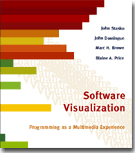
Stasko, J., Domingue, J., Brown, M., and Price, B. (eds) (1998)
Software Visualisation: Programming as a Multimedia Experience,
Cambridge Mass., MIT Press.
In the past decade, high-quality interfaces have become standard in a growing number of areas such as games and CD-ROM-based encyclopedias. Yet the overwhelming majority of programmers edit their code using a single font within a single window and view code execution via the hand insertion of print statements. Software Visualisation (SV) redresses this imbalance by using typography, graphics, and animation techniques to show program code, data, and control flow.
This book describes the history of SV, techniques and frameworks for its construction, its use in education and program debugging, and recent attempts to evaluate its effectiveness. In making programming a multimedia experience, SV leaves programmers and computer science researchers free to explore more interesting issues and tackle more challenging problems.
Psychology
A Contemporary Introduction
Scott, P. J. and Spencer, C. P. (eds) (1998)
Psychology: A Contemporary Introduction.
Blackwell Publishers.
Psychology: A Contemporary Introduction is a comprehensive introductory text in psychology written specifically for European Undergraduate students. The book starts with a life-span developmental perspective which establishes a human cognitive basis for understanding the discipline. It then explores some of the technical and mechanistic accounts through biological and cognitive perspectives. Then it seeks to round off the picture with a detailed look at social contexts and the individual. Unusually for a general undergraduate text, the book includes specialist chapters which focus on environmental psychology, clinical and health psychology and workplace psychology. The book is associated with all the usual paraphernalia of the modern undergraduate text such as study aids for students and lecturers, quizzes, but it is also supported by the PSYCLE software series (whose modules are linked from the text).